
About us
KARDIS is a Korean company providing AI-based results design and indicator solutions. We set measurement criteria for development cooperation projects at the design stage and check that they are kept through to the end.
About KARDIS
KARDIS
Korea AI Results Design & Indicator Solutions
카르디스 | 한국 AI 성과설계·지표 솔루션
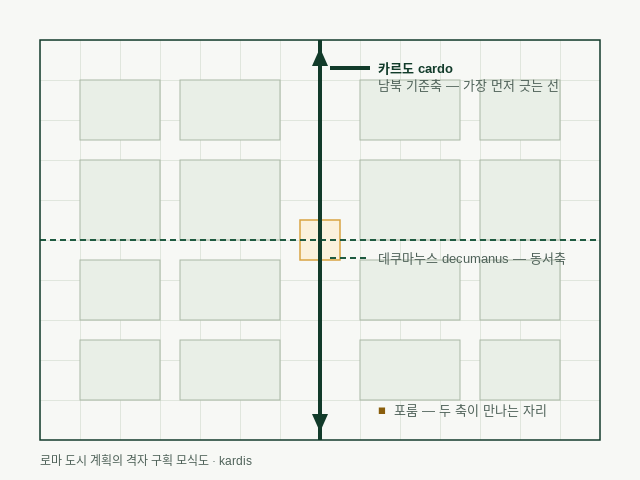
When Roman surveyors laid out a city, the first thing they drew was a straight north–south baseline, the cardo. Only once that line was in place could the roads and plots be set out. The name KARDIS comes from it.
Development cooperation projects work the same way. Data collection, analysis and reporting fall into place only once it is clear what will be measured and how. KARDIS draws that first line.
Design comes first. Delivery follows.
How we use AI
AI takes on repetitive checking and collection; people make the judgements. Sections written by AI are marked separately in every result document.
Document checks
AI reads PDMs, M&E plans and reports against set criteria and drafts a rating for each item, citing the supporting sentences from the document.
Country monitoring
AI collects political, economic and social developments in priority partner countries every day, summarises them in Korean and notes what they mean for projects. Source links are always provided.
Indicator history
AI keeps a record of each agency's indicator definitions, their revision history, and examples of sound and weak indicators, and reuses them as the basis for later checks. The more cases are recorded, the more accurate the checks become.
Judgement and design
Final ratings, overall comments and the final measurement design sheet are decided by an expert, who brings in field context and institutional circumstances that AI cannot see.
Why measurement design matters
We analysed 5,000 completed projects from the World Bank Independent Evaluation Group (IEG) ratings in which outcome, quality at entry, quality of supervision and M&E quality were all rated.
Average outcome rating by M&E quality
6-point scale. Outcome, preparation and supervision ratings all rise with M&E quality
The design stage is relatively weak
Within the same project, quality at entry (3.99) was rated lower than quality of supervision (4.32). Projects where preparation was rated lower made up 36.8%, about four times those where it was rated higher (9.7%).
The same holds in fragile settings
The outcome gap between projects with strong and weak M&E was 0.99 points in non-fragile countries and 0.98 points in fragile and conflict-affected countries — effectively the same. Difficult conditions are no reason to scale back M&E.
Project factors matter more than region
Differences in outcomes between regions were statistically significant but explained only about 2% of the variation. Design and M&E have a larger influence.
Note on interpretation M&E quality and outcomes were rated by the same evaluators, so the results show an association, not a causal effect. The data cover World Bank projects; care is needed when applying them to Korean ODA.
Source: World Bank Group, IEG World Bank Project Performance Ratings (CC BY 4.0, as of 2 October 2026), Original data. Analysis: KARDIS (t-test, ANOVA, MANOVA, α = .05)
Before your project starts,let us check the measurement design together
Tell us the project name and its current stage (planning, inception, implementation or completion), and we will explain the next steps.